HDS stands for « hébergeur de données de santé », French for « health data host ». It's a French certification, set out in the Public Health Code, for hosting health data collected as part of prevention, diagnosis, care, or social and medico-social support. A host certified HDS has been audited by an independent body: the certification doesn't promise "zero risk" — it attests that a precise framework is being followed.
Why cycle data is health data
A basal temperature chart, cervical mucus observations, period dates, an intention to conceive: this information says something about your health, your fertility, and your intimate life. The EU's General Data Protection Regulation (GDPR) places data concerning health in a category of its own. Processing it is prohibited in principle, except under strict conditions, including the person's explicit consent (Article 9).
This isn't theoretical. In 2019, the NGO Privacy International showed that 61% of the period-tracking apps it tested automatically sent data to Facebook as soon as the app was opened, before any consent was given. In 2021, the US Federal Trade Commission finalized a decision against the Flo app, accused of sharing users' health data with Facebook, Google, and other companies despite its privacy promises.
These examples show what can happen when protecting cycle data isn't designed in from the start.
What HDS certification checks
The certification framework is published by France's Agence du Numérique en Santé (digital health agency). Its current version, 2.0, dates from April 2024. In short, it checks four things.
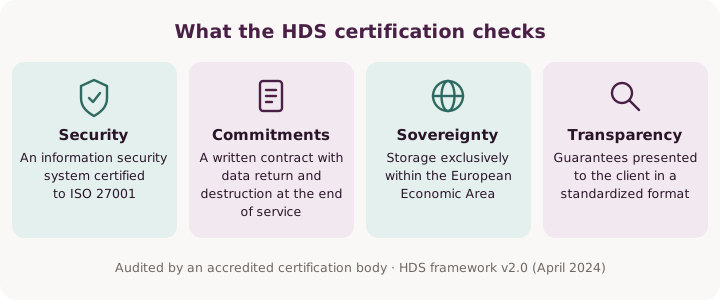
What HDS certification checks, per framework v2.0.
The certification is issued by an accredited certification body: that's what sets it apart from a simple self-declaration by the host itself. The framework also requires the host to disclose to its client where the data is stored.
Why Ovulate made this choice
We wanted to apply the highest standard from the start, rather than reach it after an incident. Three reasons.
- The sensitivity of the data. Fertility, pregnancy, intimate life: this is information whose circulation we don't want to see slip out of control.
- Proof, not a promise. A certification audited by a third party can be checked. A sentence on a homepage can't.
- Consistency with our core principle. Your observations stay on your phone first. Sharing with your sympto-thermal professional or your partner is consented to and end-to-end encrypted. The servers involved are hosted with an HDS-certified host.
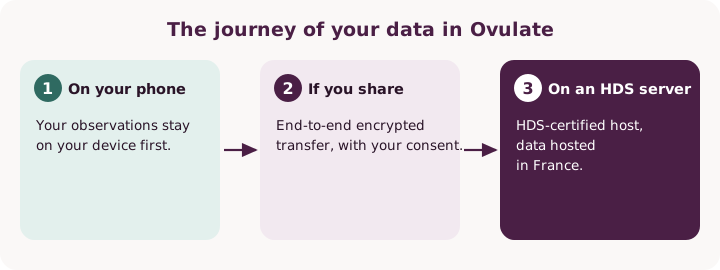
The journey of your data in Ovulate.
Our host, Clever Cloud, a French company, announced in January 2025 that it had obtained HDS certification for all six activities covered by the framework. It appears on the official list of certified hosts kept by the Agence du Numérique en Santé, where you can verify it yourself. Its HDS-certified datacenters are located in France (the Paris region, Roubaix, Gravelines), and it's in France that Ovulate hosts the data you choose to share.
What to ask a cycle-tracking app
Whichever app you use, four questions are worth asking:
- Where is my data hosted, and in which country?
- Is the host HDS-certified? You can check the answer on the official list.
- Is my data shared with third parties, for advertising or audience measurement?
- Can I export and delete it?